
Ectopic Pregnancy & Laparoscopic Management
It often starts like a normal pregnancy. A missed period. A positive test. A quiet hope.
And then—pain on one side. Spotting. A dizziness that feels “not normal.”
Dr. Kausha Shah says, “This is exactly the kind of story I don’t want you to ignore. Because when early pregnancy comes with pain or bleeding, our first job is not to guess—it’s to confirm where the pregnancy is.”
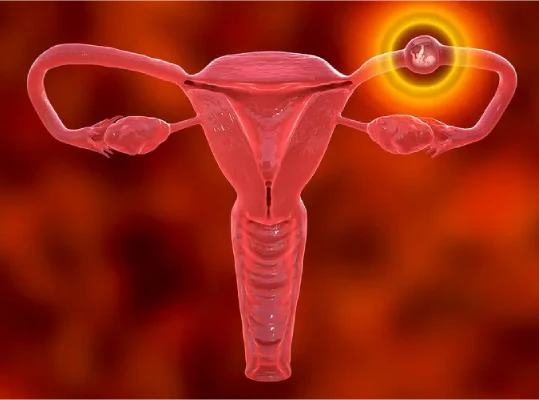
In India too, doctors see this more often than people realize. Studies from Indian hospitals report ectopic pregnancy in about 1–2% of pregnancies, and one recent tertiary-care study from Eastern India reported an incidence around 2.1% among pregnant patients evaluated. “So if your test is positive but something feels off,” Dr. Kausha adds, “please don’t wait at home. An early pregnancy scan and the right blood tests can catch it before it becomes dangerous.”
At K.K. Speciality Clinic & Hospital (Dahisar East) Mumbai, Dr. Kausha Shah (MRCOG(UK), DNB, FCPS, FICOG, DGO, DFP) has over 15 years of experience caring for women through emergencies, fertility journeys, and everything in between. If you’re searching for a gynaecologist in Dahisar because of pain and a positive pregnancy test, this guide is for you and focused on what matters: safety and fast action.
What ectopic pregnancy really means
A pregnancy is meant to grow inside the uterus. In an ectopic pregnancy, the fertilized egg implants outside the uterus—most often in a fallopian tube. The tube cannot stretch like the uterus, so the pregnancy cannot continue safely. If it grows, it can rupture the tube and cause internal bleeding, which can become an emergency.
That’s why ectopic pregnancy is never something to “wait and watch” at home.
A moment Dr. Kausha Shah sees often (a real-Patient story)
A young woman came in with her husband. She looked calm, but her hand kept holding the right side of her lower tummy.
“Doctor, I’m pregnant… but I’m not excited. I have this pain. And a little bleeding.”
Dr. Kausha Shah checked vitals, asked a few gentle questions, and then said something simple but powerful:
“Before we talk about good news, let’s confirm one thing—where is the pregnancy located?”
That one sentence is the turning point in ectopic pregnancy care. Because the location decides the treatment—and protects life.
Symptoms you should never ignore
Ectopic pregnancy can start mild and then worsen quickly. Please seek urgent care if you have:
- One-sided lower abdominal or pelvic pain
- Vaginal spotting or bleeding
- Shoulder-tip pain (sometimes linked to internal bleeding)
- Dizziness, weakness, fainting
- Sudden severe pain that increases fast
If an ectopic pregnancy ruptures, it can be life-threatening. Early evaluation matters.
Why an early scan matters (and how doctors confirm ectopic pregnancy)
Many women ask: “My urine test is positive. Why do I need more tests?”
Because a urine test confirms pregnancy, but it does not confirm where the pregnancy is.
To diagnose ectopic pregnancy, doctors typically use:
- Clinical assessment + vital signs
- Blood tests (serial beta-hCG trends)
- Ultrasound (often transvaginal), looking for an intra-uterine pregnancy vs ectopic signs
- Checks for internal bleeding if symptoms suggest rupture
This is exactly why an early pregnancy scan can be life-saving—especially when there is pain or bleeding.
Treatment options for ectopic pregnancy
Treatment depends on your stability, scan findings, beta-hCG levels, pain intensity, and rupture risk. The goal is always: save the patient first, then protect fertility when possible.
Careful monitoring (expectant management) — only in selected cases
Sometimes the body may resolve an early ectopic pregnancy on its own, but only when:
- The patient is stable
- Pain is mild
- Beta-hCG is low and falling
- There are no scan signs of risky bleeding
This approach still needs strict follow-up. It is not a “do nothing” plan—it is a monitored plan.
Medical treatment (methotrexate injection) — for early, stable cases
If the ectopic is detected early, and the patient is stable without signs of rupture, doctors may use methotrexate. This medication stops the pregnancy tissue from growing. Follow-up is essential because hCG must be tracked until it becomes negative.
Dr. Kausha Shah explains these points before medical treatment:
- You must be stable and able to return for follow-up visits
- Blood tests are needed to confirm hCG is falling
- Pain can happen after injection, but severe pain must be reviewed urgently
- A waiting period before trying to conceive again is commonly advised (doctor will guide you individually)
Surgical treatment — when safety demands fast action
Surgery is recommended when:
- Rupture or internal bleeding is suspected
- Pain is severe or worsening
- The ectopic is high-risk/large
- The patient is unstable
- Medical treatment is not suitable or fails
When possible, laparoscopic surgery is commonly preferred because it is minimally invasive.
Laparoscopic surgery for ectopic pregnancy — what happens and why it helps
Patients often fear surgery because they imagine a big incision. Laparoscopy is different.
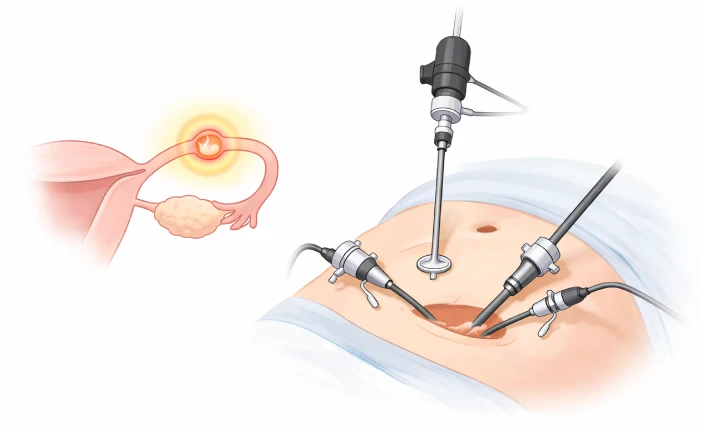
In laparoscopic management:
- Surgery is done under general anesthesia
- Small cuts are made in the abdomen
- A camera and fine instruments are used
- The ectopic pregnancy is removed safely
- Based on the tube’s condition, the surgeon may:
- Remove the ectopic pregnancy and try to preserve the tube (in selected cases), or
- Remove the affected tube if it is badly damaged or bleeding heavily
Why many doctors prefer laparoscopy (when feasible):
- Smaller incisions
- Often faster recovery
- Better surgical visibility
- Lower wound-related discomfort for many patients
- Shorter hospital stay in many cases
Dr. Kausha Shah — experience, qualifications, and patient-focused approach
Dr. Kausha Shah is a Gynaecologist & Obstetrician and Infertility Specialist with over 15 years of experience. She consults at K.K. Medical Centre (Dahisar West) and K.K. Speciality Clinic & Hospital (Mumbai). She is a member of the Indian Medical Association (IMA). Education & Training- MBBS — Maharashtra University of Health Sciences, Nashik (2006)
- DGO, DFP, FCPS, DNB — Obstetrics & Gynecology, Nowrosjee Wadia Maternity Hospital, Parel, Mumbai
- MRCOG — Royal College of Obstetricians and Gynaecologists, London (2016)
- FICOG — Fellow of Indian College of Obstetricians & Gynecologists (2019)
- MD — USAIM, Seychelles (2010)
- She worked at NWMH from 2006 to 2009. She then served as an Assistant Professor at JJ Group of Hospitals from 2009 to 2011. From 2011 to 2013, she worked at KEM Hospital, where she also took on responsibilities as a Unit Head and Postgraduate Teacher (OBG-GYN), actively involved in clinical mentoring, training, and academic guidance of residents.
- K.K. Medical Centre and Hospital (2013–till date)
- Member of Royal College of Obstetricians & Gynaecologists (UK), 2016
- D.K. Tank Prize for Best Paper Presentation, 2009
Recovery, emotions, and planning the next pregnancy
Recovery is both physical and emotional—and both deserve attention.
After treatment, follow-up commonly includes:
- Monitoring hCG until it returns to non-pregnant levels
- Reviewing scan/surgery details
- Guidance on when it’s safe to try again
- Planning an early pregnancy scan in the next pregnancy
Many women conceive successfully after an ectopic pregnancy. If fertility support is needed, Dr. Kausha Shah also guides patients with fertility evaluation and planning.
Patient reviews
“Dr. Kausha Shah explained everything so calmly. I felt safe from the first minute. The treatment was timely and clear.”
“I was terrified of surgery, but doctor explained laparoscopy in simple words. Recovery was smoother than I expected.”
“The team acted fast when my pain increased. They didn’t delay and that made all the difference.”
“Post-treatment follow-up was excellent. Doctor guided me about planning my next pregnancy and early scan.”
“Clinic is well managed, staff is supportive, and Dr. Kausha is patient, practical, and confident.”
FAQs
Can ectopic pregnancy become normal later?
No. It cannot grow safely outside the uterus, so treatment is needed to prevent complications.
Will I always need surgery?
Not always. Some early, stable cases can be treated medically, but surgery is needed in many cases depending on safety.
What is the benefit of laparoscopic surgery?
Laparoscopic surgery is minimally invasive and often allows faster recovery with smaller cuts compared to open surgery (when feasible).
Can rupture happen even after injection treatment?
Yes, it can. That’s why follow-up and knowing emergency warning signs are essential.
Can I get pregnant again after ectopic pregnancy?
Many women do. Your doctor will guide timing and will usually recommend an early scan in the next pregnancy.
When should I rush to the hospital?
Severe pain, fainting, dizziness, shoulder pain, heavy bleeding—these can suggest internal bleeding and need urgent evaluation.
Early action saves life — and protects fertility
If your pregnancy test is positive and you have pain or bleeding, don’t self-diagnose. The safest step is to consult early and confirm the pregnancy location. Early diagnosis, the right treatment plan, and careful follow-up can protect both your health and your future fertility.
Book an appointment with Dr. Kausha Shah
– Dr. Kausha Shah consults at K.K. Speciality Clinic & Hospital (Dahisar East) and K.K. Medical Centre (Dahisar West), Mumbai.
– K.K. Speciality Clinic & Hospital (Dahisar East): Ground Floor, A Wing, Sunder Baug CHSL, Swami Vivekananda Marg, Opp. Manav Kalyan Kendra, Mumbai – 400068 | Call: +91 9930775753
– K.K. Medical Centre (Dahisar West): Ground Floor, Gayatri Krupa, Behind Kanderpada Bus Stop, Opp. Majestic Hotel, Mumbai – 400068 | Call: +91 90222 90406 / 98201 90406